
Some books change your life forever. To Kill a Mockingbird transformed mine. It woke me up to the issue of racial inequality, something that hadn't been a part of my world until then.


Written with warmth and humor, To Kill a Mockingbird emphasizes courage, tolerance and decries prejudice. So it was with surprise that I found out this novel had a long history of being banned in many schools across North America.
In 2002, Brian Bauld wrote, "I have been teaching English to Nova Scotian students from Grade 7 to Grade 12 for 28 years. Without doubt, the book that has gained the most favour with my students has been To Kill a Mockingbird. From the thousands of students who have had the privilege to read Harper Lee's one-book-wonder, I would be hard pressed to think of any but the most obtuse and inane who could interpret it as racist."
For myself and many others, the words obtuse and inane best describe those that have implemented the ban of this book.
 In 2001, the City Library of Chicago began a program designed to encourage literacy. Endorsed by mayor Richard Daley and city officials, the One Book, One Chicago initiative picked To Kill a Mockingbird as its first book for the entire city to read. By the way, Chicago has a robust black population. How anyone could think that this book hurts African Americans is beyond comprehension.
For myself and many others, the words obtuse and inane best describe those that have implemented the ban of this book.

"That this book is still being taught, despite ongoing resistance, is a credit to those principals and teachers who have placed quality above quackery," Bauld aptly states. "My experience is that students are drawn naturally to stories of justice, mercy, fairness, selflessness and honour, especially when handled by great artists."
There have been numerous "classics" banned through the ages; Lord of the Flies, Catcher in the Rye, Brave New World, 1984, Ulysses and ironically Fahrenheit 451, a novel that reveals a future culture where books are banned and burned.

Even the Bible has been banned.
 But I was surprised to learn that Mark Twain's great American novel, Adventures of Huckleberry Finn, has not just been banned but is actually undergoing editing changes. NewSouth Books plans to release a version of this classic with the "n" word (nigger) taken out (used 219 times) and replaced with "slave." They will also remove the word "injun," a colloquial reference to Native Americans.
It's important to remember that in using these words, Twain, like Harper Lee, was critiquing racism not endorsing it.
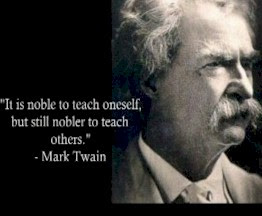
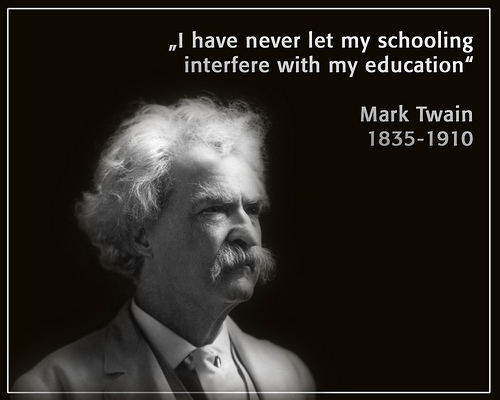
 One can only imagine what Twain himself would say about this edit of Huck Finn. Known for his acerbic wit and speaking his mind, one of Twain's famous quotes, "I have never let my schooling interfere with my education," could well be used in this instance.
A few years ago, I was writing a feature article on modern cowboys for a national magazine. I added some historical context to the piece and wrote about my favorite childhood game, "Cowboys and Indians." The editor said this phrase was not politically correct and could hurt a whole people group. It would have to be changed to read "Cowboys and First Nations people." Well, I had NEVER played cowboys and First Nations people, and when I pointed out it was not meant to be derogatory but merely historically representative, she refused to budge. That section was edited out.

Peter Messent, author of The Cambridge Introduction to Mark Twain is very critical of editing this American classic. He writes, "As Twain himself said, 'The difference between the almost right word and the right word is really a large matter - it's the difference between the lightning bug and the lightning.'
"I respect the motivation of Alan Gribben, the senior Twain scholar who is responsible for the new edition, and who wishes to bring the book back into easy classroom use, believing 'that a significant number of school teachers, college instructors and general readers will welcome the option of an edition of Twain's...novels that spares the reader from a racial slur that never seems to lose its vitriol.'
 "But it's exactly that vitriol and its unacceptable nature that Twain intended to capture in the book as it stands. Perhaps this is not a book for younger readers. Perhaps it is a book that needs careful handling by teachers at high school and even university level as they put it in its larger discursive context, explain how the irony works, and the enormous harm that racist language can do. But to tamper with the author's words because of the sensibilities of present-day readers is unacceptable. The minute you do this, the minute this stops being the book that Twain wrote."
Do you feel books like To Kill a Mockingbird and The Adventures of Huckleberry Finn should be banned or edited to remove inflammatory words - like nigger?
Have we become so overly sensitive to some terms that we cannot judge their context in classic literature?
Any English instructors out there? Do you take these edits as a slight to your teaching capabilities - that you may not be able to present the discursive context in a way your students would comprehend? Would you rather teach an edited version of these novels?

There have been numerous "classics" banned through the ages; Lord of the Flies, Catcher in the Rye, Brave New World, 1984, Ulysses and ironically Fahrenheit 451, a novel that reveals a future culture where books are banned and burned.

Even the Bible has been banned.

It's important to remember that in using these words, Twain, like Harper Lee, was critiquing racism not endorsing it.
A few years ago, I was writing a feature article on modern cowboys for a national magazine. I added some historical context to the piece and wrote about my favorite childhood game, "Cowboys and Indians." The editor said this phrase was not politically correct and could hurt a whole people group. It would have to be changed to read "Cowboys and First Nations people." Well, I had NEVER played cowboys and First Nations people, and when I pointed out it was not meant to be derogatory but merely historically representative, she refused to budge. That section was edited out.

Peter Messent, author of The Cambridge Introduction to Mark Twain is very critical of editing this American classic. He writes, "As Twain himself said, 'The difference between the almost right word and the right word is really a large matter - it's the difference between the lightning bug and the lightning.'
"I respect the motivation of Alan Gribben, the senior Twain scholar who is responsible for the new edition, and who wishes to bring the book back into easy classroom use, believing 'that a significant number of school teachers, college instructors and general readers will welcome the option of an edition of Twain's...novels that spares the reader from a racial slur that never seems to lose its vitriol.'

Do you feel books like To Kill a Mockingbird and The Adventures of Huckleberry Finn should be banned or edited to remove inflammatory words - like nigger?
Have we become so overly sensitive to some terms that we cannot judge their context in classic literature?
Any English instructors out there? Do you take these edits as a slight to your teaching capabilities - that you may not be able to present the discursive context in a way your students would comprehend? Would you rather teach an edited version of these novels?


